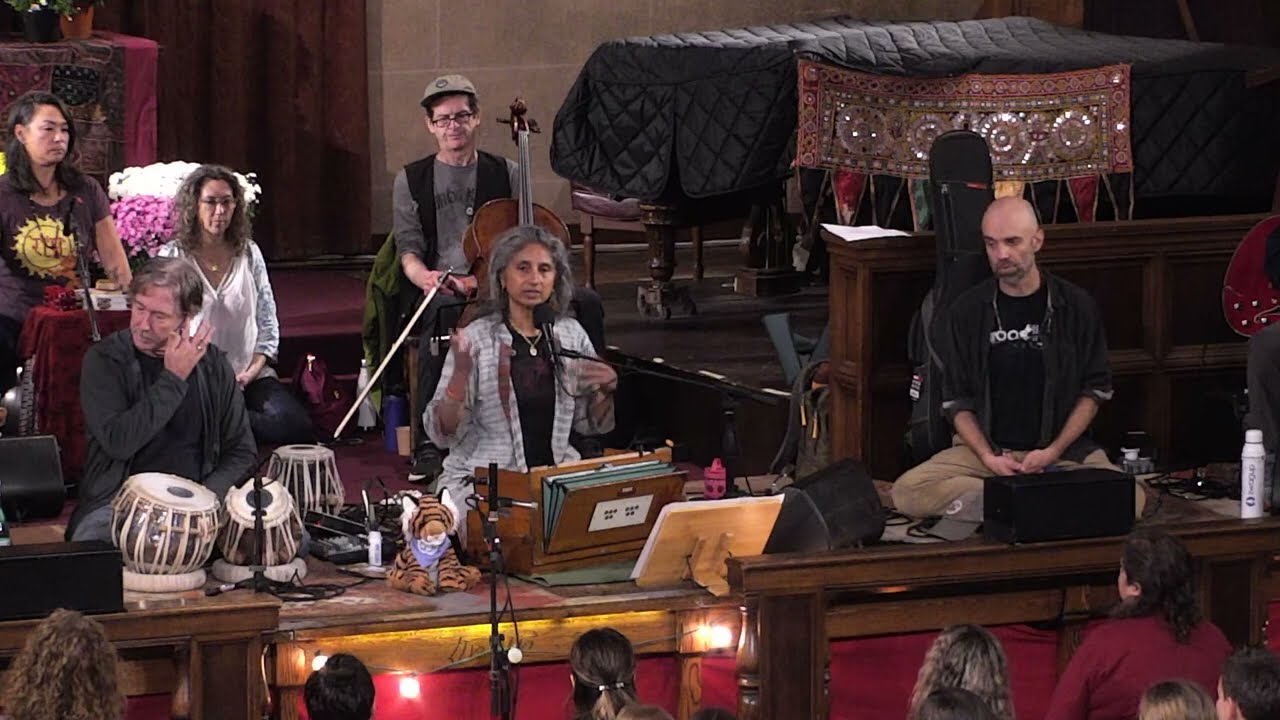
"Indigo Sea" is a kirtan composition that uses the traditions of sacred chanting and devotional music to guide listeners toward deeper meditation, spiritual resonance, and inner stillness. Produced by Siobhán Moore and released in 2018 as part of the collaborative work between Ajeet and Rising Appalachia, the piece demonstrates how the marriage of traditional kirtan practice with contemporary musical arrangements creates a portal for contemplative experience and emotional release.
What is Kirtan and How Does It Function as Spiritual Practice?
Kirtan is an ancient yogic and bhakti (devotional) practice rooted in Sanskrit mantra and call-and-response chanting. Unlike meditation in silence, kirtan harnesses the vibratory power of sacred sound—mantra—to attune the body, mind, and heart to higher states of consciousness. The practice operates on the principle that sound itself is a form of energy that can restructure our internal states when engaged with intention and awareness.
In kirtan, a lead vocalist or musician initiates a phrase or invocation, and participants (or listeners, in the case of recorded kirtan) respond, creating a feedback loop of sacred vibration. This call-and-response format mirrors the natural rhythm of breath and heartbeat, anchoring practitioners in the present moment. The repetition of mantras—often in Sanskrit, Hindi, or other sacred languages—is believed to activate specific energy centers (chakras) in the body and dissolve psychological blockages that inhibit spiritual development.
The Collaboration Between Ajeet and Rising Appalachia
The composition "Indigo Sea" emerges from a unique cultural and artistic convergence: the meeting of Appalachian folk traditions with South Asian devotional practice. Ajeet, a kirtan artist and spiritual teacher, partnered with Rising Appalachia, a folk ensemble known for integrating social consciousness and earth-based spirituality into their music. This collaboration honors the principle that spiritual truth transcends cultural boundaries—that the soul's longing for connection, healing, and transcendence speaks in many languages and musical idioms.
Produced by Siobhán Moore, "Indigo Sea" was recorded in 2018 and released later that year as part of Ajeet Music's catalog. The production choices—instrumentation, tempo, vocal treatment—reflect a deliberate effort to make kirtan accessible to Western audiences while maintaining the integrity and depth of the traditional practice. The "indigo" imagery itself carries symbolic weight: in classical Hindu philosophy, indigo is associated with the sixth chakra (the third eye), the seat of inner vision and intuitive knowing. The "sea" suggests vastness, depth, and the oceanic quality of consciousness itself.
How Does Sacred Sound Create Altered States of Consciousness?
The mechanism by which kirtan affects consciousness operates on multiple levels. Physiologically, sustained chanting changes breathing patterns, lowers heart rate, and activates the parasympathetic nervous system—the body's rest-and-digest response. This parasympathetic activation counteracts chronic stress and nervous system dysregulation, creating a biological foundation for contemplative experience.
Psychologically, the repetition of mantra occupies the thinking mind, temporarily silencing the internal commentary and analytical function that ordinarily dominates awareness. In the gaps between repetitions, in the spaces created by focused sound, the deeper layers of consciousness—what contemplative traditions call the witnessing awareness or pure consciousness—become accessible. This is not a blank state; rather, it is a state of heightened sensitivity and receptivity.
On the energetic level (as understood in yogic philosophy), mantras carry specific vibrations that correspond to chakras, elements, and aspects of divine consciousness. Each mantra invokes a particular quality of being: compassion, strength, wisdom, devotion, abundance. By chanting or listening to these frequencies with intentional awareness, practitioners attune themselves to these qualities, gradually integrating them into their lived experience.
What Role Does Melody and Musical Arrangement Play in Kirtan?
While kirtan's essence is the mantra itself, the melody and musical setting are not incidental. A well-crafted raga or melodic structure creates emotional resonance and makes the practice more accessible to the heart. "Indigo Sea," through its production, balances traditional kirtan elements with contemporary musical sensibilities—layering instruments, vocal harmonies, and rhythmic textures that deepen the listener's immersion.
The use of acoustic and possibly electronic instrumentation, combined with Appalachian folk elements, creates a liminal space: neither fully traditional nor fully modern, but rather a bridge between them. This aesthetic choice mirrors the spiritual function of kirtan itself, which bridges the ordinary and the sacred, the personal and the transpersonal.
Kirtan as a Tool for Emotional Release and Healing
Kirtan is not primarily about entertainment or aesthetic pleasure (though these may be side effects). Rather, it is a technology for emotional catharsis and subtle body healing. When we chant or listen deeply to sacred sound, we create permission for suppressed emotions—grief, longing, joy—to surface and move through the system. The repetitive, rhythmic structure of kirtan provides a safe container for this release, much as music in general can unlock emotional states that talk therapy alone cannot access.
For many practitioners, kirtan sessions involve spontaneous crying, laughter, trembling, or waves of peace. These are not signs of instability but rather signs of successful energy movement and the dissolution of held trauma. The piece "Indigo Sea," with its contemplative pacing and evocative imagery, likely invites this kind of subtle emotional catharsis in listeners willing to surrender to it.
The Modern Resurgence of Kirtan Practice in the West
In the past two decades, kirtan has moved from a niche practice confined to ashrams and yoga studios into mainstream consciousness. Artists like Ajeet, Krishna Das, and others have brought kirtan into concert halls, festivals, and streaming platforms, making it available to millions who would never step into a traditional spiritual community. This democratization reflects both a genuine hunger for contemplative practice and a recognition that ancient technologies of consciousness need not be locked away in religious institutions.
The collaboration documented in "Indigo Sea" exemplifies this evolution: it is not packaged as "exotic Eastern spirituality," nor is it diminished into New Age commodification. Instead, it presents itself as what it is—a sincere practice of devotion and sound, rooted in ancient wisdom, expressed through contemporary artistry.
Where to Go From Here
If "Indigo Sea" resonates with you, consider exploring the broader kirtan tradition through regular listening or live practice. Many cities now have kirtan circles or evening chanting sessions, often offered by yoga studios or spiritual communities. You might also investigate the specific mantras used in different kirtan pieces to understand their meanings and energetic associations. Reading about the chakra system and Sanskrit sacred language will deepen your appreciation of why certain sounds are paired with certain invocations. Finally, approach kirtan with the understanding that you are not passively consuming music—you are entering into a participatory spiritual technology that asks for your heart's attention and your voice or inner listening.